
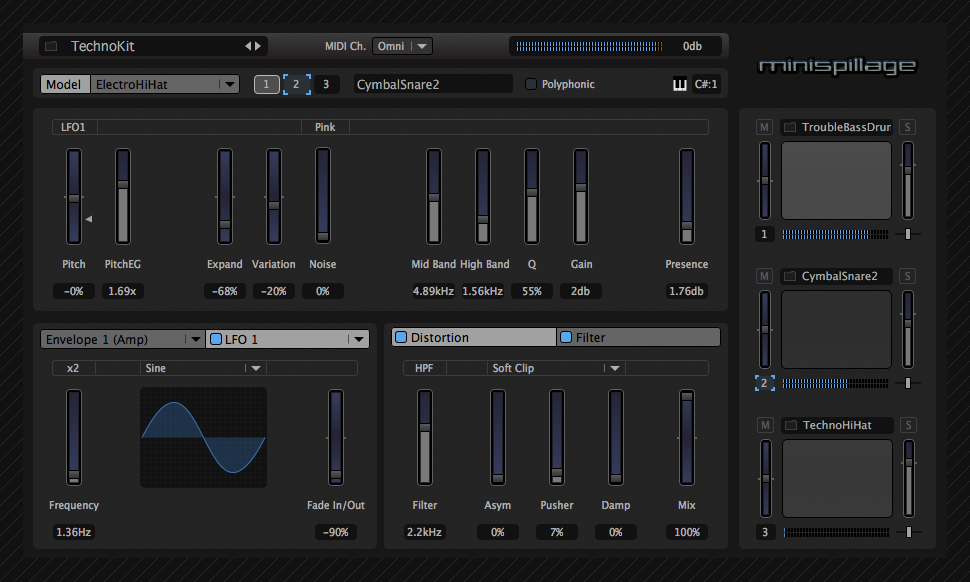

MiniSpillage is a free professional quality drum synthesizer plugin featuring high resolution 64-bit DSP processing.
MiniSpillage includes 3 exclusive drum synthesis algorithms along with distortion effects and resonant filters.
Depending on your interest, Chapter 1 can represent a young girl's imaginative escape, a scholarly mystery involving Emily Brontë, or a contemporary slow-burn narrative. Key Interpretations of "Emily's Diary"
Emily is frequently portrayed as a character who is "not good at people" or feels "alone," finding solace in her writing.
The keyword refers to several distinct literary and media works, ranging from classic Canadian literature and Gothic mysteries to modern adult serials. emily%27s diary - chapter 1
In scholarly versions, like Emily Wilde’s Encyclopaedia of Faeries , Chapter 1 emphasizes Emily as a "meticulous researcher" who prefers the company of books and her dog over social interaction.
Whether it is Emily Brontë's hidden life or a modern character's personal trauma, the first chapter usually hints at a "lifetime of secrets" waiting to be unraveled. Depending on your interest, Chapter 1 can represent
Many versions begin with Emily in a new or changing setting—such as a stormy night at a farmhouse or a research trip to the "far north".
For more details on a specific book, you can check the Emily the Strange Wiki or summaries on eNotes . In scholarly versions, like Emily Wilde’s Encyclopaedia of
This mystery novel centers on a professor’s discovery of a 150-year-old diary belonging to Emily Brontë. Chapter 1 typically establishes the "Gothic overtones" and the academic squabbles surrounding the theory that Brontë committed suicide.
In the sequel Emily Climbs , Chapter 1 uses Emily Byrd Starr's diary to bridge the gap between her childhood and her fourteenth spring at New Moon farmhouse. It highlights her "imaginative and introspective mind" as she navigates her environment through writing.
"A true wonder… The sheer range of sounds that can be coaxed from the instrument is nothing short of staggering."
Review by
Computer Music Magazine
"Awesome sound, intuitive work flow and—thanks to the powerful models—enormous flexibility."
Review by
Beat Magazine (Editor's Choice)